AI Agents

Explore the cutting-edge world of AI agents—autonomous software programs designed to streamline tasks, make decisions, and deliver intelligent solutions across industries. By enhancing large language models (LLMs), agents bridge the gap between AI potential and real-world, industry-specific applications, enabling tailored solutions for healthcare, finance, e-commerce, and beyond.

Explore the cutting-edge world of AI agents—autonomous software programs designed to streamline tasks, make decisions, and deliver intelligent solutions across industries. By enhancing large language models (LLMs), agents bridge the gap between AI potential and real-world, industry-specific applications, enabling tailored solutions for healthcare, finance, e-commerce, and beyond.

AI Agents Posts

All Categories
Featured image for Cuttlesoft's "Agent Sprawl Is the New Shadow IT" post showing a six-by-three grid of eighteen circular agent icons centered against a dark midnight-zone background, with three icons highlighted in seafoam and surrounded by soft halos and tracker rings to represent the AI agents enterprise IT and security teams actually monitor, and fifteen dim outlined icons representing the unmonitored agents employees have installed across coding assistants, MCP servers, browser extensions, and SaaS tools, with a faint scatter of even smaller noise dots fading into the dark at the edges of the frame to suggest the larger uninventoried fleet beyond, visually arguing that AI agent sprawl has become the new shadow IT problem for governance, supply chain security, and budget accountability in 2026.
May 5, 2026 • Frank Valcarcel

Agent Sprawl Is the New Shadow IT

An engineer wires up a Claude Code workflow on Monday. A product manager installs a Notion agent on Tuesday. By Friday there are six new identities operating against company data with no clear owner.

Low-poly geometric iceberg illustration in seafoam teal against a midnight zone navy night sky scattered with stars, with the small crystalline peak above the waterline and a much larger faceted mass extending deep below the surface — a visual metaphor for the gap between the $70/month sticker price of AI coding tools like GitHub Copilot, Cursor, and Claude Code and the $1,000+ per-developer monthly cost that heavy agentic AI usage actually drives in 2026.
May 1, 2026 • Frank Valcarcel

What AI Costs Your Development Partner

Anyone offering a firm discount on a software project based on AI productivity gains is making a bet, not a measurement. Here is what AI actually costs the teams building your software

Three representations of an agent loop stacked vertically, progressing from a solid circle to a segmented circle to a node-and-edge graph, illustrating the spectrum from implicit to fully explicit control flow
April 14, 2026 • Frank Valcarcel

The Agent Loop: One Pattern, Three Frameworks

Every agent framework runs the same loop: call the LLM, execute tools, repeat until done. Here is what that looks like across three frameworks, and what breaks when you scale it.

Pixel-art Claude Code ghost mascots on a dark background illustrating agent teams: a large coral lead agent at center connected by dashed lines to purple backend, blue frontend, and yellow tests sub-agents, each labeled by role, with a terminal prompt reading claude --team "Add Stripe checkout with tests" showing how Claude Code orchestrates multi-agent collaboration to parallelize complex development tasks.
February 24, 2026 • Frank Valcarcel

Setting Up Claude Code Agent Teams on macOS

Agent teams let you break work into focused tasks where each teammate gets a fresh context window dedicated to its piece of the problem. This guide walks through the full setup on macOS, from enabling the feature flag to managing your first multi-agent session with tmux.
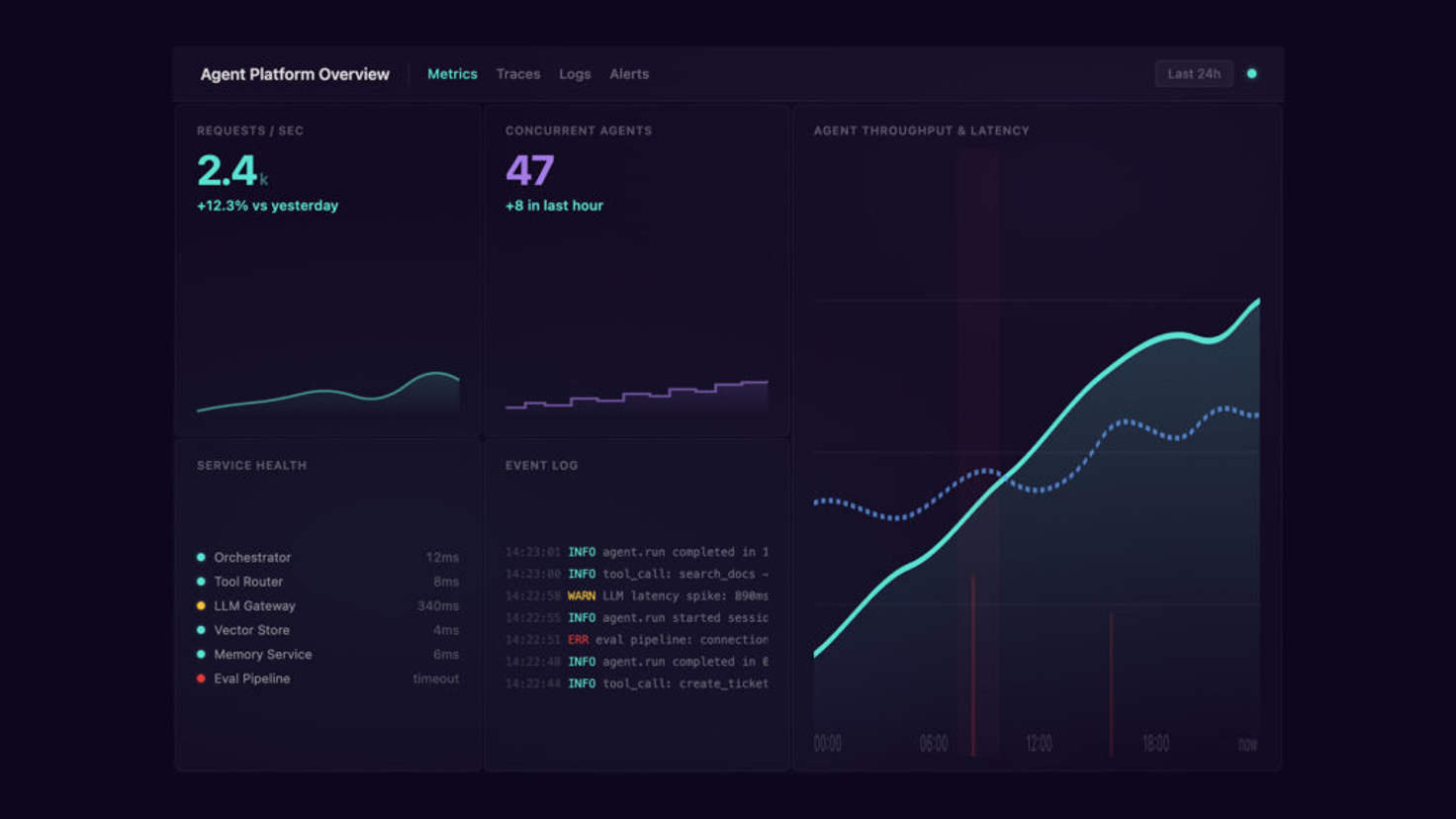
Dark monitoring dashboard showing an agent platform overview with real-time metrics including 2.4k requests per second, 47 concurrent AI agents, service health indicators for orchestrator and LLM gateway components, a throughput and latency time-series chart, and a streaming event log with tool calls and error traces.
February 24, 2026 • Frank Valcarcel

AI Agent Platforms Compared: From Enterprise to Self-Hosted

Your team built an AI agent. It works in a demo. Now someone asks: where does it actually run? A new category of product has emerged to solve this: agent platforms. Think of them as fleet management software for AI agents. This post compares the major options and how to choose.

Illustration of a small, determined knight in weathered medieval armor and a bucket helmet, wearing a tattered red cape, striding across barren cracked earth with sword drawn, surrounded by a swirling cloud of scattered wooden alphabet letters representing Token Guard, a GitHub Action that monitors and guards against token context bloat in AI coding agent workflows by counting the tokens in LLM instruction files committed to repositories."
February 10, 2026 • Frank Valcarcel

Token Guard: Keeping Your Agent Context Lean in CI

Token Guard is a GitHub Action that counts tokens in your agent context files and enforces limits in CI. Here’s why we check agent context into our repos, and why keeping it lean matters for team collaboration.

Claude Code terminal interface displaying ASCII art logo with command '/tips for advanced users' - guide to advanced Claude Code workflows and productivity techniques
February 3, 2026 • Frank Valcarcel

Claude Code: Tips and Tricks for Advanced Users

Most developers try Claude Code and form an opinion based on basic usage. But the engineers getting the most out of it treat it as a full development environment. Here are the advanced techniques that separate power users from everyone else.

Blueprint-style architecture diagram of an AI agent framework showing the core orchestration loop of observe, think, act, and repeat, with components for planning, state management, LLM reasoning, tool execution, and persistent memory connected by directional data flows on a dark grid background.
March 27, 2025 • Frank Valcarcel

A Practical Guide to Agent Orchestration Frameworks

There are at least a dozen frameworks competing to be the foundation for your agent architecture. This post breaks down how each one thinks about the problem, where it shines, and where it will cost you time. We are not ranking them. The right choice depends on your use case.

The Pydantic.ai logo features a stylized pink starfish or sea star icon next to black text reading 'PydanticAI' against a gradient background that transitions from cyan to soft lavender. This elegant, minimal design reflects the framework's focus on clean, structured AI development. The vibrant gradient background suggests the dynamic and innovative nature of this new agent framework from the creators of Pydantic, while maintaining a professional tech aesthetic.
December 11, 2024 • Frank Valcarcel

Pydantic.ai: Building Smarter, Type-Safe AI Agents

The team that brought type safety to Python web development with Pydantic has just unveiled their take on AI development: Pydantic.ai. This new framework reimagines how we build AI applications by bringing Pydantic’s legendary validation capabilities to the world of Large Language Models.

Other Categories

Let's work together

Tell us about your project and how Cuttlesoft can help. Schedule a consultation with one of our experts today.

Contact Us