Is Python Django Right For Your Project?

Discover the Cuttlesoft Difference
We’re not just developers; we’re innovators using Python Django to craft web applications that set industry standards. Our solutions guarantee scalability, efficiency, and security — turning your complex problems into simple, elegant solutions.
Cuttlesoft's Django Advantage
Rapid Development
Robust Security
Scalable and Reliable
Built-In Admin
Senior-Level, Experienced
Accelerate Your Growth
Accelerate your project timelines using Django’s clean, pragmatic design. This high-level framework enables our team to streamline the development process, shifting your project from an initial concept to a market-ready product faster than ever.
Fortified Security with Django
Security isn’t just an add-on; it's embedded in our development process. Django’s robust security framework is designed to shield your applications from the most prevalent threats, including SQL injection and cross-site scripting.
Maximize Resources for Scalability
Grow your application with Django’s inherent scalability. Designed to handle growth effortlessly, Django supports increasing user demands without necessitating a corresponding increase in resources.
Featured Case Study
FAMU Tech TransferWhen the Florida Agriculture and Mechanical University needed a software partner to develop their patented technology transfer solution, they knew they required a firm with unique talents.
Read More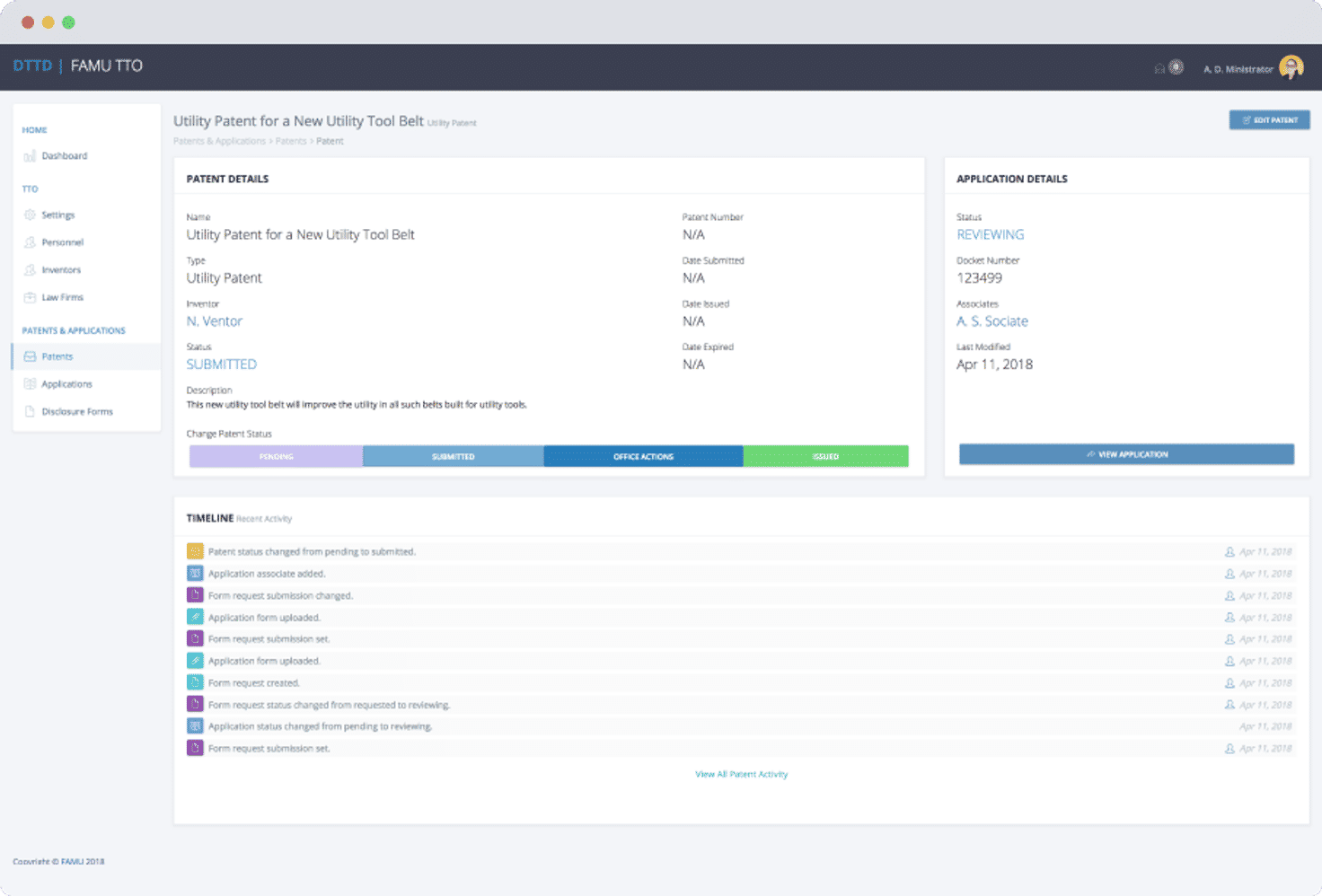
Trusted by these and other amazing partners


Precision Engineering
We pride ourselves on our precise engineering and mastery of Django. Our approach is streamlined with our rigorous standards for quality and efficiency. This combination ensures that our client’s software is robust, maintainable, and aligned with the latest in technological advancements
- Rigorous Testing
- Full Alignment


Your Vision, Our Django Expertise
We recognize that no two projects are the same. That's why we specialize in creating customized Django applications that are precisely aligned with your unique business requirements. Our team works closely with you to understand your specific challenges and opportunities, ensuring that the final product is not just a solution, but the right solution.
- Django REST Framework
- Graphene
- Channels
- Celery
Django Development FAQs
Django, Flask, and FastAPI are all strong Python web frameworks, but they solve different problems. Django is a full-stack framework with a "batteries-included" philosophy: it ships with an ORM, authentication system, admin interface, form handling, migration tooling, and built-in security protections out of the box. Flask is a micro-framework that gives you a minimal core and lets you assemble your own stack. FastAPI is purpose-built for high-performance APIs with async-first design and automatic OpenAPI documentation. Cuttlesoft chooses Django for most client projects because the built-in features eliminate weeks of setup time that Flask and FastAPI require you to handle manually. Django's automatic database migrations alone save significant effort on any project that evolves over time. For clients who need API-only backends without a traditional web interface, we sometimes pair Django REST Framework with a React or React Native frontend, giving us the best of both worlds: Django's mature ORM and security model on the backend, with a modern JavaScript frontend. For workloads that are primarily I/O-bound API calls with high concurrency requirements, FastAPI can be the better choice, and we are happy to recommend it when the project warrants it.
Django powers a wide range of production applications, from early-stage MVPs to large-scale platforms handling millions of users. Instagram, Pinterest, Disqus, Mozilla, and The Washington Post all run on Django. At Cuttlesoft, we have used Django to build SaaS platforms with multi-tenant architectures, HIPAA-compliant healthcare backends with FHIR API integration, e-commerce systems with subscription billing and inventory management, university technology transfer platforms (FAMU Tech Transfer), internal tools and admin dashboards, RESTful and GraphQL APIs that serve web and mobile clients, and data-intensive applications with complex reporting requirements. Django's ORM supports PostgreSQL, MySQL, SQLite, and Oracle, and its migration system makes schema changes straightforward as your application evolves. The built-in admin interface is particularly valuable for clients who need non-technical staff to manage data without a custom CMS build.
Django's primary API tooling comes from Django REST Framework (DRF), a mature and widely adopted library for building RESTful APIs. DRF provides serializers for validating and transforming data, viewsets and routers for standard CRUD operations, built-in authentication backends (token, session, JWT via third-party packages), throttling and permission classes for access control, pagination, filtering, and search out of the box, and a browsable API interface that makes testing and debugging faster during development. For projects that need GraphQL instead of REST, we use Graphene-Django, which maps Django models to GraphQL types and integrates with Django's authentication and permission system. We also use Django Channels when a project requires WebSocket support for real-time features like live notifications, chat, or collaborative editing. Channels extends Django's request-response model to handle long-lived connections using ASGI, which means you can add real-time features without replacing your entire framework.
Django has one of the strongest security track records of any web framework. Its security features are enabled by default, not opt-in, which means common vulnerabilities are prevented even if the developer does not explicitly configure them. Out of the box, Django protects against cross-site scripting (XSS) by escaping template output automatically, cross-site request forgery (CSRF) through token validation middleware, SQL injection through its ORM's parameterized queries, clickjacking via the X-Frame-Options middleware, and host header attacks through the ALLOWED_HOSTS setting. Beyond Django's defaults, Cuttlesoft implements additional security measures based on the project's requirements. For financial applications, we add field-level encryption for sensitive data, comprehensive audit logging, and multi-factor authentication. For healthcare applications, we implement HIPAA-compliant access controls, encrypted PHI storage, and BAA-covered cloud infrastructure. Django's active security team also publishes security releases promptly when vulnerabilities are discovered, and its LTS (Long Term Support) releases receive security patches for three years.
Yes. Django is designed for scalability, and some of the highest-traffic websites in the world run on it. Instagram served hundreds of millions of users on Django before and after its acquisition by Meta. The key to scaling Django is not the framework itself but how you architect the infrastructure around it. At the application layer, Django supports database connection pooling, query optimization through select_related and prefetch_related, multi-level caching (per-view, per-fragment, low-level cache with Redis or Memcached), and asynchronous task processing with Celery for offloading long-running operations. At the infrastructure layer, Django applications scale horizontally behind load balancers, with read replicas for database-heavy workloads and CDNs for static and media content. We deploy Django projects on AWS or GCP using containerized deployments (Docker and Kubernetes) with auto-scaling groups that respond to traffic spikes automatically. The practical answer is that Django will not be your bottleneck. Database queries, third-party API calls, and unoptimized business logic will be. We architect around those constraints from the start.
We follow a sprint-based process with two-week cycles. Every Django project begins with a discovery phase where we define the data model, map out API contracts, identify third-party integrations, and establish the deployment architecture. From there, we build iteratively, delivering working functionality at the end of each sprint that you can review and test. Our standard Django stack includes Django with Django REST Framework for the API layer, PostgreSQL as the primary database, Redis for caching and Celery task queuing, Docker for consistent development and deployment environments, and CI/CD pipelines that run automated tests on every pull request. We write tests throughout development, not as an afterthought. Our Django projects maintain test coverage across unit tests (pytest), integration tests for API endpoints, and end-to-end tests where appropriate. Throughout the engagement, you work directly with senior engineers. We do not layer account managers between you and the people writing the code. Learn more about how we structure projects on our process page.
Timeline depends on scope, but here are realistic ranges from our experience. An MVP with user authentication, a core data model, REST API, and admin interface typically takes six to 10 weeks. A full-featured SaaS platform with multi-tenancy, payment integration (Stripe), role-based permissions, reporting dashboards, and third-party integrations usually takes three to six months. An enterprise application with complex business logic, multiple integration points, data migration from a legacy system, and regulatory compliance requirements can take six months or longer, often delivered in phased releases. Django's built-in features (authentication, admin, migrations, ORM) compress these timelines compared to frameworks where you assemble everything from scratch. The admin interface alone saves weeks of development time on projects where non-technical users need to manage data. The biggest variable is not the framework but the number and complexity of integrations with external systems.
Yes. We have migrated applications from Rails, PHP (Laravel, WordPress backends), Flask, and legacy .NET systems to Django. Migration projects typically follow three phases. First, we audit the existing application: its data model, business logic, API surface, integrations, and any undocumented behavior that users depend on. Second, we build the Django replacement in parallel, mapping the existing schema to Django models and implementing business logic with full test coverage. Data migration scripts handle the translation between the old schema and the new one, with validation checks at every step to ensure nothing is lost or corrupted. Third, we run both systems in parallel during a transition period, then coordinate the cutover during a maintenance window. For applications that cannot tolerate downtime, we use a strangler fig pattern: routing traffic to the new Django application feature by feature while the legacy system continues to handle everything else. This approach is slower but eliminates the risk of a big-bang migration.
Yes. Django applications require ongoing maintenance because the ecosystem moves forward continuously. Django publishes a new feature release roughly every eight months and maintains LTS releases with security patches for three years. Python itself releases annually. Third-party packages like DRF, Celery, and django-allauth publish their own updates on independent schedules. Our maintenance engagements cover Django and Python version upgrades (including testing for breaking changes in your codebase), dependency audits and security patching, database performance tuning and query optimization, infrastructure monitoring and incident response, and feature enhancements as your product evolves. We also handle the operational work that many teams defer until it becomes a problem: keeping Docker base images current, rotating secrets, reviewing access controls, and ensuring your CI/CD pipeline stays functional as tooling changes. A Django application that falls behind on upgrades accumulates technical debt that becomes exponentially more expensive to address later. Regular maintenance prevents that. Contact us to discuss a support plan.
Hear What Our Clients Are Saying

"I love the Cuttlesoft team and would love to work with them again."
Latest Django Insights and Tutorials

TWIL 2019-10-11

Data Privacy in Django: Frank at Djangocon 2018

Data Pseudonymization in Django
"Django gives you a real advantage. Leveraging the community, packages, and resources allows us to develop complex stacks, effortlessly."

Why you'll love working with Cuttlesoft
Women-Owned Business
Sometimes a rarity in the tech industry, being a women-owned tech business gives us a unique perspective on the market and guides us to hear and understand all voices. This leadership helps us solve problems using diversity as a first principle.
On-Shore Developers
Work with a dedicated team of on-shore developers, project managers, and product strategists. We never outsource our work and stay with you from start to finish, ensuring that your project is in the very best hands.
True Partners
Here's the thing—software is hard work, and software development requires true, deep partnerships between top-level management and the development teams. We're here to help you find your balance.