
Build Powerful Applications with Ruby on Rails

Why Choose Cuttlesoft for Ruby on Rails?
We don't just build applications; we engineer success. Our dedicated team of experts bring a deep understanding of Rails and a client-centric approach to innovation and problem-solving. This ensures not only functional and high-performing applications but also a transparent experience aligned to your timeline and budget.
The Cuttlesoft Difference
Rapid Development
Continuous Integration and Deployment
Scalable and Reliable
Expert Developers
Ongoing Support
Scalability
Effortlessly scale your applications to match your growing business needs with our team of expert developers. Our software is always designed for dynamic expansion.
Cost Efficiency
Reduce development costs without compromising on quality. Our Ruby on Rails solutions streamline operations and maximize your budget.
Speed to Market
Launch your applications quicker than ever with Ruby on Rails’ efficient coding conventions and our streamlined development process.
Featured Case Study
Scaling E-commerce with Hunt A KillerHow Cuttlesoft helped “Hunt A Killer” ditch Shopify and grow subscriptions with custom e-commerce and fulfillment software.
Read More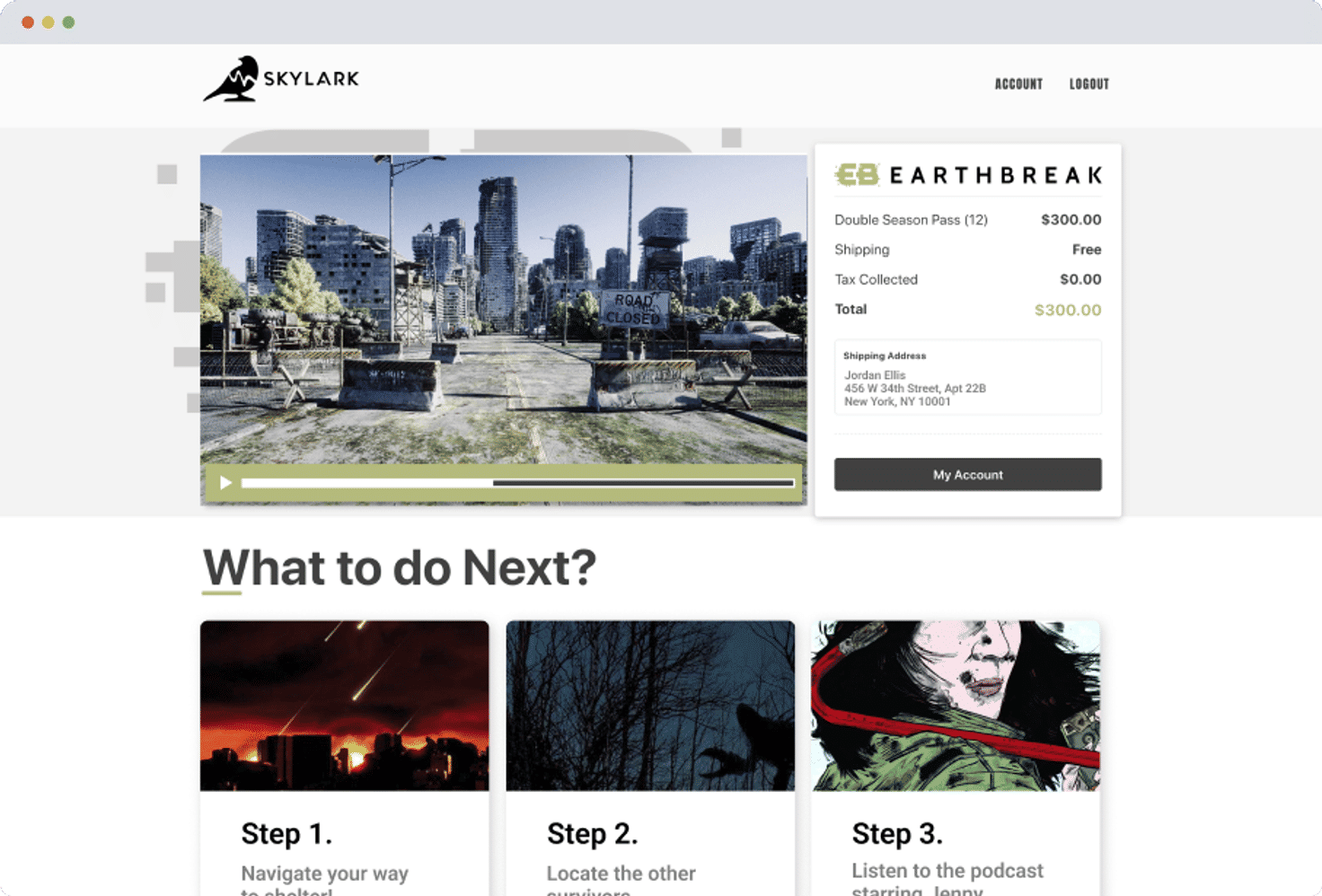
Trusted by these and other amazing partners


Customized Ruby on Rails Development
At Cuttlesoft, we create unique Ruby on Rails solutions perfectly aligned with your business objectives. Our approach means your product will not only meet but exceed expectations, delivering functionality and user experience designed specifically for your target audience. Trust us to transform your vision into a high-performing reality.
- Rigorous Testing
- Full Alignment


Advanced Ruby on Rails Technologies
Leverage Cuttlesoft’s deep expertise in the latest Ruby on Rails technologies to build innovative, future-proof applications. Our team stays at the forefront of development trends, ensuring your applications benefit from the most advanced, reliable, and secure Ruby on Rails features available.
- SideKiq
- RSpec
Rails Development FAQs
Rails and Django are both mature, full-stack web frameworks with similar philosophies: convention over configuration, built-in ORM, migration tooling, authentication, and admin interfaces. The main differences come down to language ecosystem and community focus. Rails uses Ruby and has deep roots in e-commerce, subscription platforms, and content-driven applications. Django uses Python and is stronger in data science, machine learning, and scientific computing use cases because of Python's ecosystem. Cuttlesoft is one of the few consultancies with deep production experience in both frameworks. We choose between them based on the project, not personal preference. For clients who need tight integration with data pipelines, ML models, or Python-based analytics tools, we recommend Django. For clients building e-commerce platforms, marketplace applications, or products where rapid prototyping and Rails' rich gem ecosystem provide an advantage, we use Rails. For API-heavy projects that serve React or React Native frontends, both frameworks work well, and the decision often comes down to team familiarity and the broader technology context of the project.
Rails excels at database-backed web applications where development speed matters. It is particularly strong for e-commerce platforms (Shopify was built on Rails), subscription and membership businesses, SaaS products with multi-tenant architectures, marketplace and two-sided platforms, content management systems, and API backends serving mobile and single-page applications. At Cuttlesoft, we built the custom e-commerce and fulfillment platform for Hunt A Killer, migrating them off Shopify to a Rails-based system that could handle their subscription box model, custom fulfillment logic, and growing order volume. Rails was the right choice there because of its mature ecosystem for payment processing (Stripe via the stripe-ruby gem), background job handling (Sidekiq), and the speed at which we could ship complex business logic. GitHub, Basecamp, Airbnb, and Shopify itself are all built on Rails, which gives you a sense of the scale and complexity the framework can handle.
Yes. Rails continues to evolve with regular releases and an active core team led by its creator, David Heinemeier Hansson. Recent Rails versions have introduced Hotwire (Turbo and Stimulus) for building interactive UIs without heavy JavaScript frameworks, Action Mailbox and Action Text for handling inbound email and rich text content, Solid Queue and Solid Cache for database-backed job queuing and caching without Redis, and improved multi-database support for read replicas and horizontal sharding. The Rails community is smaller than it was at its peak hype, but the framework is mature, stable, and still widely used in production. The companies running Rails (Shopify, GitHub, Basecamp, Hey, Cookpad) continue to invest in it because it remains productive for building full-featured web applications. For Cuttlesoft, the question is never whether a framework is trendy. The question is whether it is the right tool for the project. Rails is the right tool for a lot of projects.
Yes. Shopify processes millions of transactions per day on Rails. GitHub handles hundreds of millions of requests daily. The perception that Rails does not scale comes from its early years when the tooling around deployment and concurrency was less mature. That has changed significantly. Modern Rails applications scale through multiple layers. At the application level, Rails supports database connection pooling, fragment and Russian doll caching, background job processing with Sidekiq (which uses threads for high concurrency), and lazy loading optimizations to reduce N+1 query problems via strict_loading. At the infrastructure level, Rails applications deploy behind load balancers with horizontal scaling across multiple application servers, read replicas for database-heavy workloads, and CDNs for static assets. We deploy Rails applications on AWS or GCP using containerized environments with auto-scaling. Ruby's concurrency story also improved significantly with the introduction of Ractors in Ruby 3 and continued performance gains in Ruby 3.3+, with YJIT (Yet Another Ruby JIT) delivering meaningful speed improvements in production workloads.
Rails has a strong security model with protections enabled by default. Out of the box, Rails guards against cross-site request forgery (CSRF) with authenticity tokens embedded in every form, cross-site scripting (XSS) by escaping all output in ERB templates automatically, SQL injection through Active Record's parameterized queries, mass assignment vulnerabilities through Strong Parameters (requiring explicit whitelisting of permitted attributes), and session hijacking through encrypted, signed cookies. The Rails security team is responsive and publishes CVEs and patches promptly when vulnerabilities are discovered. Beyond the framework defaults, Cuttlesoft implements additional security measures based on the project's requirements: rate limiting, IP-based access control, multi-factor authentication, audit logging, and encryption at rest for sensitive data. For clients in regulated industries like finance or healthcare, we layer compliance-specific controls (PCI-DSS, HIPAA) on top of Rails' built-in protections.
Yes. Platform migrations are one of the most common reasons clients come to us for Rails development. We migrated Hunt A Killer from Shopify to a custom Rails platform when their subscription box business outgrew what Shopify could handle. The standard pattern for Shopify-to-Rails migrations involves exporting product catalogs, customer records, and order history from Shopify's API, rebuilding the storefront and checkout flow in Rails with payment processing through Stripe or a similar provider, implementing custom business logic that Shopify's app ecosystem could not support (in Hunt A Killer's case, subscription management and fulfillment orchestration), and running both systems in parallel during a transition period to prevent disruption. We also migrate from other platforms and frameworks: WordPress backends that need custom application logic, legacy PHP or .NET systems, and older Rails applications that need a major version upgrade and codebase modernization. The approach is always incremental, with data validation at every step and zero tolerance for data loss.
Our standard Rails stack is built for maintainability and production readiness. On the backend, we use Rails with Active Record and PostgreSQL as the primary database, Sidekiq for background job processing (email delivery, report generation, webhook handling, and other asynchronous work), Redis for caching, session storage, and Sidekiq's job queue, and RSpec with FactoryBot for test coverage. For frontend rendering, we use Hotwire (Turbo and Stimulus) when the project calls for server-rendered HTML with interactive behavior, or a decoupled React frontend consuming a Rails API when the UI complexity warrants a single-page application architecture. For deployment, we use Docker containers deployed to AWS or GCP with CI/CD pipelines that run the full test suite, security checks, and linting on every pull request before merging. We also use Rubocop for code style enforcement and Brakeman for static security analysis, both integrated into the CI pipeline so issues are caught before they reach production.
Rails' convention-over-configuration philosophy means projects move faster than they would in more minimal frameworks, but timeline still depends on scope. An MVP with authentication, a core data model, basic CRUD functionality, and payment integration typically takes six to 10 weeks. A full-featured platform with complex business logic, third-party integrations, admin dashboards, and role-based permissions usually takes three to six months. E-commerce migrations from platforms like Shopify involve additional complexity around data migration, payment provider setup, and parallel-running both systems, and typically take three to five months depending on catalog size and customization requirements. We work in two-week sprints with working builds delivered at the end of each cycle. You can test features on a staging environment throughout the project rather than waiting for a single delivery at the end. Learn more about our engagement structure on our process page.
Yes. Rails applications require active maintenance because Ruby, Rails, and the gem ecosystem all evolve on independent release cycles. Rails publishes new feature releases roughly annually, with security patches for supported versions in between. Ruby itself releases annually with performance and security updates. Gems like Devise, Sidekiq, and Stripe publish their own updates that can introduce breaking changes. Our maintenance engagements for Rails clients cover Ruby and Rails version upgrades (including testing for deprecations and breaking changes), gem dependency audits and security patching using tools like Bundler Audit, database performance tuning and query optimization, Sidekiq job monitoring and failure handling, infrastructure monitoring with alerting for downtime, error spikes, and performance degradation, and feature enhancements as the product evolves. A Rails application that falls behind on upgrades becomes progressively harder and more expensive to update. Staying within one or two versions of the latest Rails release is significantly cheaper than catching up after years of deferred maintenance. Contact us to discuss a support plan for your Rails application.
Hear What Our Clients Are Saying

"Cuttlesoft’s level of communication set them apart for me."
Latest Ruby on Rails Posts
"Ruby is beautiful and intuitive, and Rails strikes a nice balance between performing magic and being able to make things work."

Why you'll love working with Cuttlesoft
Women-Owned Business
Sometimes a rarity in the tech industry, being a women-owned tech business gives us a unique perspective on the market and guides us to hear and understand all voices. This leadership helps us solve problems using diversity as a first principle.
On-Shore Developers
Work with a dedicated team of on-shore developers, project managers, and product strategists. We never outsource our work and stay with you from start to finish, ensuring that your project is in the very best hands.
True Partners
Here's the thing—software is hard work, and software development requires true, deep partnerships between top-level management and the development teams. We're here to help you find your balance.