
Your team has been tasked with integrating a large language model into your product. You have seen the benchmarks, read the hype, and built a shortlist of models that all claim state-of-the-art performance. But here is the uncomfortable truth that many enterprise leaders discover only after committing budget: models that dominate leaderboards often underperform in production.
The problem is getting worse, not better. As of 2025, leading LLMs score above 90% on benchmarks like MMLU (Massive Multitask Language Understanding), up from roughly 70% just three years ago. The gap between the best open-source and closed-source models has narrowed from 17.5 percentage points to effectively zero in a single year, according to the Stanford AI Index 2025 report. When every top model aces the same test, that test no longer helps you decide which one actually fits your business needs.
So how do you actually evaluate an LLM for commercial use? We have been through this process with clients across healthcare, finance, and enterprise software, and the answer is never as simple as "pick the highest score on the leaderboard."
Why Benchmark Scores Fall Short
Public benchmarks were designed to measure general capabilities in controlled conditions. They test whether a model can answer trivia questions, complete code snippets, or reason through logic puzzles. What they do not measure is whether that model will help your customers find what they need, process your specific document formats, or integrate with your existing systems without breaking.
The disconnect between lab performance and production results is well-documented. Gartner predicts that 30% of generative AI projects will be abandoned after proof of concept by the end of 2025, citing poor data quality, inadequate risk controls, escalating costs, and unclear business value. A more recent Gartner forecast puts the number even higher for agentic AI projects, with over 40% expected to be canceled by the end of 2027. In many of these cases, the model itself was not the problem. The evaluation process was.
Consider this scenario: you need to extract information from millions of unstructured documents. If each inference takes 20 to 30 seconds, you have a throughput problem that no benchmark score will reveal. Or maybe you need to handle nuanced legal language that wasn't well represented in the training data. The model might score 95% on general knowledge tests but struggle with your specific domain.
We have covered the technical side of LLM benchmarks, including HELM, MMLU, and evaluation frameworks, in a previous post. This article focuses on the commercial decision: how do you translate all that information into a choice that works for your business?
The Three Axes of Commercial Evaluation
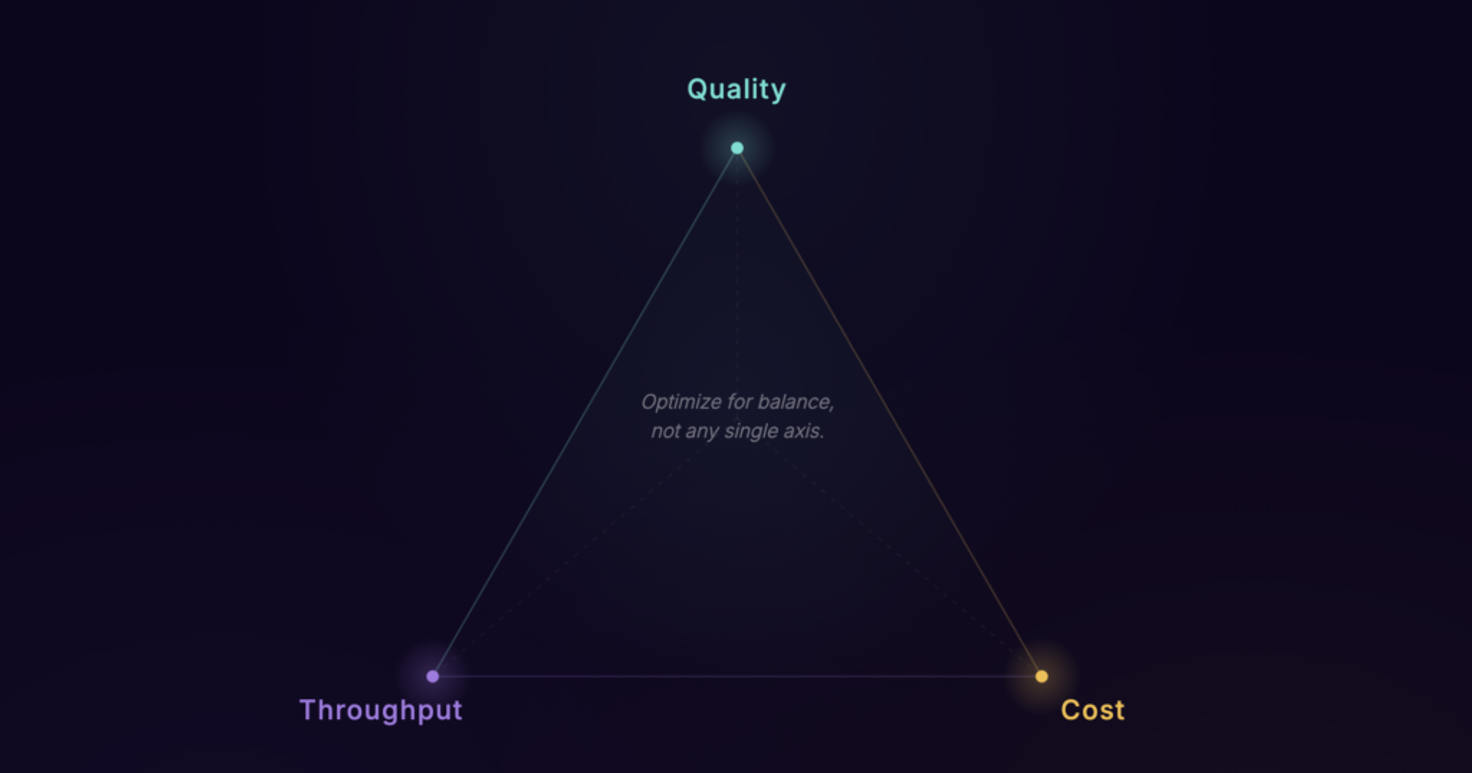
When evaluating LLMs for production use, you need to assess three interconnected dimensions: quality, throughput, and cost. Every improvement on one axis typically affects the others, so the goal is not to maximize any single metric. It is to find the right balance for your specific use case.
Quality: Does It Actually Work for Your Task?
Quality assessment goes far beyond benchmark scores. Here is what matters in practice.
Task-specific accuracy. How well does the model perform on your actual use case? Create a test set of 100 to 200 examples from your real data, manually label the expected outputs, and measure against that. This is the single most important step in the evaluation process, and the one most teams skip.
Consistency. Given the same input, does the model produce outputs that are reliably similar? For customer-facing applications, inconsistency can be a deal-breaker. Run the same inputs through the model multiple times and measure the variance.
Edge case handling. How does it behave with unusual inputs, ambiguous queries, or data that falls outside typical patterns? These are the cases that generate support tickets.
Domain knowledge. Does the model understand your industry's terminology, regulations, and conventions? A model that scores well on general medical questions may still botch the specific clinical terminology your application requires.
The key shift for enterprises is moving from "how does this model score on public benchmarks?" to "how does this model score on our data?" That means building custom evaluation datasets that reflect your actual user queries, your edge cases, and success criteria tied to your operational metrics.
Throughput: Can It Keep Up With Your Workload?
Throughput becomes critical at scale. The metrics that matter include time-to-first-token (how long until the model starts responding), tokens-per-second (how quickly it generates output once it starts), concurrency limits (how many simultaneous requests it can handle before performance degrades), and latency under load (what happens to response times when traffic spikes).
That last one deserves special attention. The 99th percentile latency, often called p99, matters more than averages for production systems. A model that responds in 200 milliseconds on average but occasionally takes 10 seconds will frustrate your users in ways that averages never reveal.
Test under realistic load conditions. A model that performs beautifully in demos might struggle when your customer support system sends 500 concurrent requests during a product launch.
Cost: What Is the Real Price Per Task?
Do not evaluate cost per token in isolation. Instead, calculate the total cost per completed task under realistic usage scenarios. This includes token pricing (both input and output, which are often priced differently), retry rates (if 10% of requests fail and need retrying, your effective cost increases accordingly), prompt overhead (long system prompts multiply quickly at scale), and the cost of human review and correction for outputs that do not meet quality standards.
A useful rule of thumb from recent research: a private LLM deployment starts to pay off when you process over two million tokens per day or require strict compliance like HIPAA or PCI. Below that threshold, API-based services are typically more cost-effective.
Tools like Artificial Analysis provide useful comparisons of quality, speed, and pricing across major providers, helping you identify the right tradeoffs for your use case.
A Practical Framework for LLM Selection
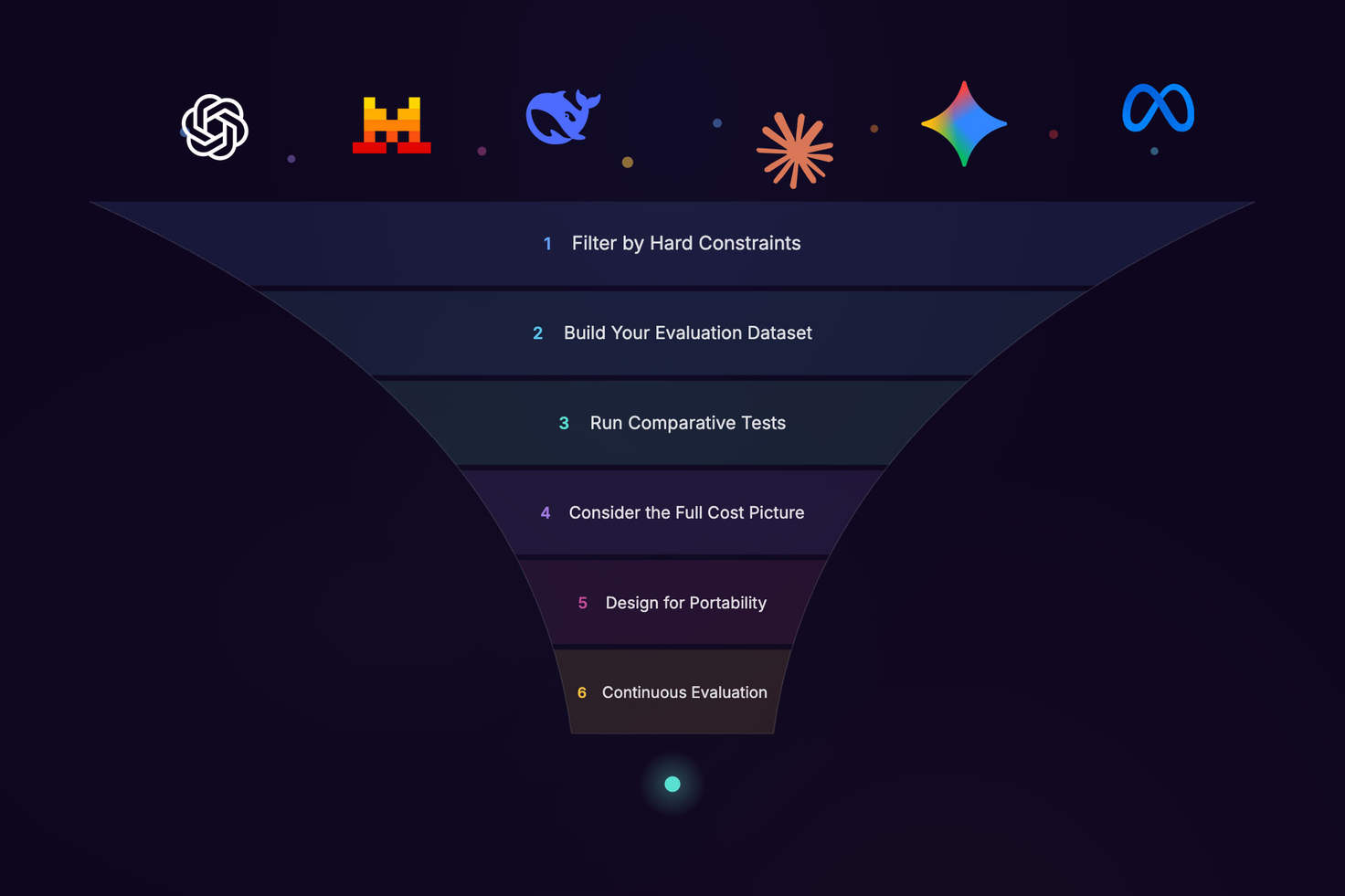
Here is a step-by-step approach that works for most commercial applications.
Step 1: Filter by Hard Constraints
Start by eliminating options that do not meet your non-negotiable requirements. Licensing matters: many open-source models have restrictions on commercial use, and some, like Meta's Llama models, require separate permission for organizations above certain user thresholds. Compliance matters: SOC 2, HIPAA, GDPR, and data residency requirements can narrow the field significantly. Context length matters: if you are processing long documents, you need adequate context windows, and the practical performance within those windows varies by model.
Step 2: Build Your Evaluation Dataset
Create a test set that reflects your actual use case. Aim for 100 to 200 examples minimum, manually labeled with expected outputs. Include edge cases and difficult scenarios, not just happy-path examples. Represent the full diversity of inputs you expect in production. If possible, include examples that have caused problems with previous solutions.
This is the step where most evaluation processes fail. Teams default to public benchmarks because building a custom dataset takes real effort. But a custom dataset built from your own data is worth more than every public benchmark combined.
Step 3: Run Comparative Tests Across Candidates
Evaluate your shortlisted models against your custom dataset. Measure accuracy against your expected outputs, latency distribution (mean, p50, p95, p99), token usage, total cost per task, and failure rates and error patterns.
Do not rely on a single evaluation run. Test multiple times to ensure consistency. And pay attention to the failure patterns, not just the failure rates. Two models might both fail 5% of the time, but one might fail randomly while the other consistently struggles with a specific input type. The second model is easier to work around.
Step 4: Consider the Full Cost Picture
Compare different model sizes to identify cost-performance inflection points. A smaller, faster model often performs nearly as well as a larger one for your specific task, at a fraction of the cost.
Consider a hybrid strategy. Use lightweight models for high-volume, low-risk tasks and reserve larger models for situations where precision or compliance is critical. This is an increasingly common pattern we see in production systems, and it can reduce costs by 60% or more while maintaining quality where it counts.
Step 5: Design for Portability
This is the step that most evaluation guides skip, and it is one of the most important. When you commit to a model and build your prompts, evaluation sets, and fine-tuning around it, switching costs are real. Design your integration with an abstraction layer between your application logic and the model provider. Use provider-agnostic patterns like Pydantic models for structured outputs, so you can swap providers without rewriting your application code.
The LLM landscape moves fast enough that the best model today may not be the best model in six months. Your architecture should make it possible to switch without a rewrite.
Step 6: Plan for Continuous Evaluation
LLM evaluation is not a one-time event. Models update, requirements change, and new options emerge. Build monitoring into your production system from day one. Track quality metrics on ongoing production traffic. Set up alerts for performance degradation. Periodically re-evaluate against competitors.
Tools like RAGAS, Arize Phoenix, and DeepEval can help automate this ongoing evaluation, especially for RAG (retrieval-augmented generation) systems.
Common Pitfalls to Avoid
Based on what we have seen in enterprise implementations, here are mistakes worth watching out for.
Premature fine-tuning. Do not invest in fine-tuning until you have validated that the base model's capabilities are close to what you need. Fine-tuning can improve accuracy on specific tasks, but it is expensive, time-consuming, and locks you to a specific model version.
Ignoring data governance. Understand what data goes to the model and what the provider does with it. This matters for compliance and competitive reasons. If your data contains anything proprietary or regulated, this constraint may be your most important filter.
Underestimating infrastructure needs. Self-hosted models require significant GPU resources, MLOps expertise, and ongoing maintenance. The total cost of ownership for self-hosting is almost always higher than teams initially estimate.
Skipping human evaluation. Automated metrics miss nuances that human reviewers catch. For high-stakes applications, human evaluation remains essential. Budget for it from the start, not as an afterthought.
Treating evaluation as a one-time event. The most common and most expensive mistake. A model that works well today can degrade after a provider update, a shift in your user base, or changes in your data. Continuous evaluation is not a nice-to-have. It is how you protect your investment.
Making the Choice
The LLM landscape offers more viable options than ever. Open-source models have closed the performance gap to the point where the choice between open and closed source is now driven by operational requirements, not capability gaps. That is good news for buyers, but it also means the evaluation process matters more, not less.
The key insight is this: benchmark scores measure capabilities in controlled conditions, but commercial success depends on performance in your specific context. The model that wins on a leaderboard is not necessarily the one that will deliver the most value for your business.
Build your own evaluation framework. Test against your own data. Measure what matters for your users. Design for portability so you are not locked in when something better comes along. That is how you move from AI hype to AI value.
Need help evaluating and integrating LLMs into your product? We have been building AI-powered applications for clients across healthcare, finance, and enterprise software, and we bring that same evaluation rigor to every engagement. Let's talk about your project.

